Physical Address
304 North Cardinal St.
Dorchester Center, MA 02124
Physical Address
304 North Cardinal St.
Dorchester Center, MA 02124

In today’s hyper-competitive market, executing a strong Go-To-Market (GTM) strategy is no longer optional; it is essential for achieving sales success and staying ahead of competitors.
Modern sales teams face a multitude of challenges, from identifying high-quality leads and scoring them accurately to creating personalized outreach campaigns and predicting pipeline performance.
Without the right tools, these tasks can be time-consuming, error-prone, and difficult to scale, leading to missed opportunities and lost revenue.
This is where AI-powered sales tools come into play. The best AI tools for sales GTM review focus on harnessing the power of artificial intelligence to automate repetitive tasks, analyze large volumes of data, and provide actionable insights.
By integrating AI into the GTM process, sales teams can prioritize the most promising leads, tailor messaging to individual prospects, forecast sales with greater accuracy, and optimize their workflows for maximum efficiency.
From AI-driven lead scoring and predictive analytics to personalized outreach and pipeline forecasting, these tools are designed to enhance every stage of the sales process.
They enable sales professionals to focus on what they do best, building relationships and closing deals while letting AI handle the data-heavy and repetitive aspects of GTM execution.
In this comprehensive review, we’ll break down the key features, benefits, pros and cons, comparisons, FAQs, and final verdict of the top AI tools for sales GTM.
Whether you are a small sales team looking to scale or an enterprise aiming to optimize a complex GTM strategy, this guide will help you identify the AI-powered solutions that deliver measurable results and drive revenue growth.
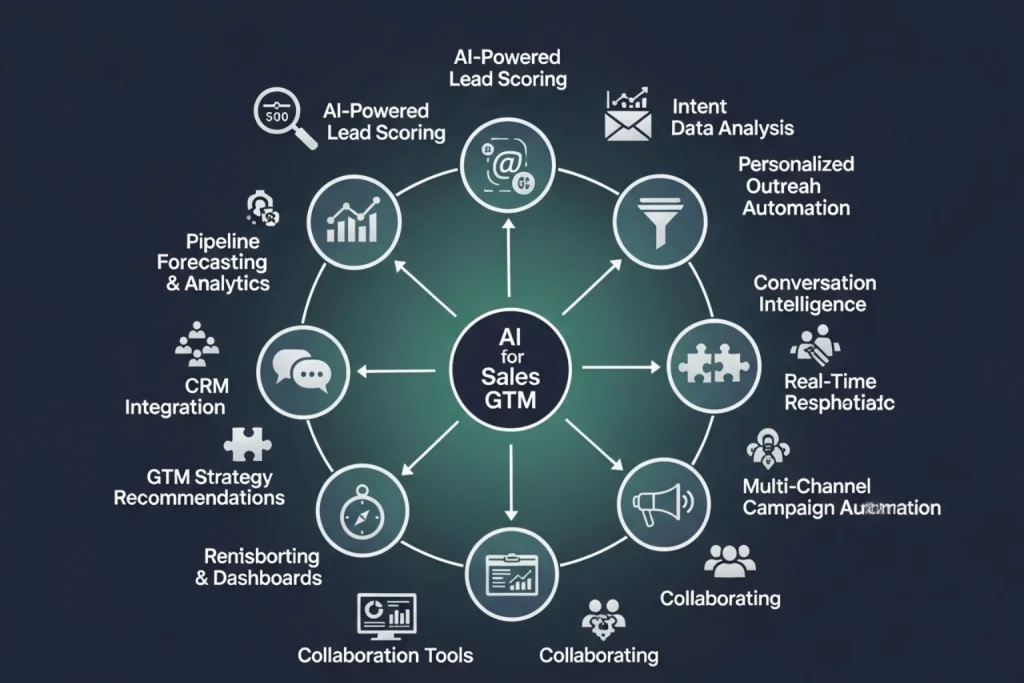
The best AI tools for sales GTM are sophisticated software platforms designed to optimize every aspect of a Go-To-Market (GTM) strategy by leveraging the power of artificial intelligence.
Unlike traditional tools that primarily automate repetitive tasks, these AI-powered solutions combine machine learning, predictive analytics, and natural language processing to provide sales teams with actionable insights, streamline workflows, and enable smarter decision-making.
One of the key advantages of these platforms is their ability to analyze buyer behavior in real time.
By examining historical interactions, engagement patterns, and intent signals, AI tools can identify high-value prospects who are most likely to convert, helping sales teams prioritize their efforts and focus on opportunities that matter most.
In addition to lead prioritization, AI tools automate outreach across multiple channels, including email, LinkedIn, and other messaging platforms.
This ensures consistent and personalized communication with prospects at scale, reducing manual effort and increasing engagement rates.
Another critical feature is predictive lead scoring. By evaluating past behaviors and signals, AI models assign accurate scores to leads, enabling sales teams to focus on prospects with the highest likelihood of conversion.
Similarly, AI-powered pipeline forecasting uses data-driven models to predict revenue outcomes, project deal closures, and provide insights into potential bottlenecks, allowing managers to make informed decisions and plan resources effectively.
Beyond outreach and scoring, these platforms also analyze conversations from calls, meetings, and emails.
This conversation intelligence enables teams to extract actionable insights, track performance metrics, and provide coaching opportunities that improve the overall effectiveness of the sales process.
Integration is seamless with most leading CRM and sales tools, ensuring that AI insights complement existing workflows rather than disrupt them.
By connecting with platforms like Salesforce, HubSpot, or Zoho, sales teams can access AI-driven recommendations directly within their everyday tools, maintaining continuity and efficiency.
Importantly, these AI platforms are not designed to replace human sales professionals. Instead, they act as intelligent assistants that augment human capabilities, helping teams work faster, make better decisions, and optimize revenue generation.
From startups looking to scale efficiently to enterprise organizations managing complex GTM strategies, the best AI tools for sales GTM empower teams to achieve consistent growth, reduce sales cycle times, and maximize conversion potential.
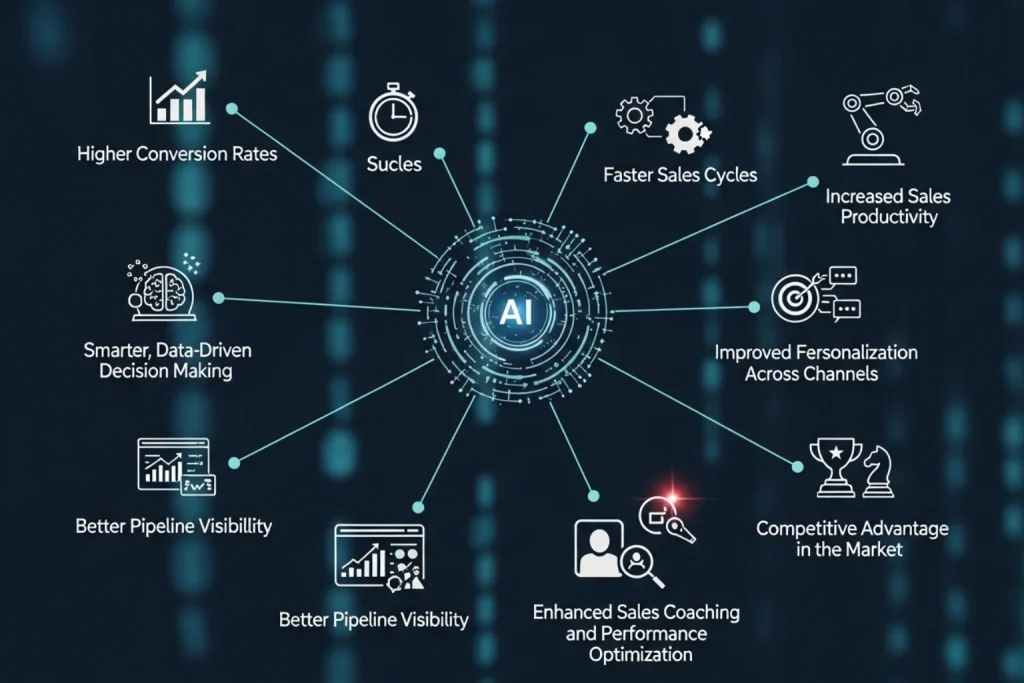
AI-powered lead scoring and intent analysis help sales teams focus on prospects who are most likely to buy.
Instead of chasing cold leads, reps engage high-intent buyers, significantly increasing win rates and overall conversion performance.
By automating follow-ups, scheduling, qualification, and nurturing workflows, AI tools eliminate delays in the sales process.
Prospects receive timely responses, reducing friction and accelerating deal progression.
Sales representatives spend less time on manual data entry, research, and repetitive outreach.
AI handles administrative tasks, allowing teams to dedicate more time to strategic conversations and closing deals.
AI tools analyze historical sales data, buyer behavior, and engagement trends to generate actionable insights.
Sales leaders can make informed decisions on targeting, segmentation, pricing strategies, and resource allocation.
Advanced predictive analytics evaluate deal stages, pipeline health, and historical performance to provide realistic revenue forecasts.
This enables better budgeting, planning, and investor reporting.
AI enables hyper-personalized messaging across email, LinkedIn, and other communication platforms.
Even at scale, outreach remains relevant and tailored to each prospect’s interests and behavior.
Real-time dashboards and analytics provide a clear overview of deal stages, bottlenecks, and performance metrics.
Sales managers gain complete visibility into pipeline health and team activity.
With conversation intelligence and performance tracking, managers can identify strengths, weaknesses, objection patterns, and missed opportunities.
This leads to continuous improvement and higher close rates.
Companies leveraging AI in their GTM strategy can respond faster, personalize better, and optimize continuously, giving them a significant edge over competitors still relying on manual processes.
AI tools significantly reduce manual work such as data entry, follow-up reminders, lead qualification, and email sequencing. This allows sales representatives to focus more on relationship-building and closing deals rather than on administrative tasks.
With predictive analytics and intent data tracking, AI tools identify high-quality prospects who are more likely to convert. This improves pipeline quality and prevents wasted effort on low-intent leads.
Modern AI platforms analyze customer behavior, past interactions, and engagement signals to generate hyper-personalized messaging. Sales teams can deliver relevant communication across email, LinkedIn, and other channels without sacrificing scale.
AI-driven forecasting models analyze historical performance, deal velocity, and pipeline trends to provide realistic revenue predictions. This helps leadership make better strategic and budgeting decisions.
By automating workflows and offering actionable insights, AI tools help teams manage more opportunities in less time. Productivity increases without needing to expand the sales team.
AI can analyze call recordings, detect keywords, sentiment, and objection patterns. Managers gain insights to coach reps more effectively and improve closing rates.
Most leading AI GTM platforms integrate with CRM systems like Salesforce, HubSpot, Zoho, and marketing automation tools, ensuring smooth data synchronization and workflow continuity.
Enterprise-grade AI tools often come with premium pricing. Advanced forecasting, deep analytics, and conversation intelligence features may require higher-tier plans that can strain smaller budgets.
Implementing AI tools may require onboarding sessions, technical configuration, and process adjustments. Sales teams need time to adapt and learn how to use advanced analytics effectively.
AI performance depends heavily on clean and accurate CRM data. Incomplete, outdated, or inconsistent data can reduce forecast accuracy and lead scoring.
Over-reliance on automation can make outreach feel robotic or impersonal. Without human oversight, messaging may lose authenticity and negatively impact customer relationships.
Although many tools offer integrations, businesses with highly customized systems may face compatibility issues or require additional technical support.
AI tools that track intent data and analyze conversations must comply with data protection regulations. Businesses need to ensure proper compliance with GDPR, CCPA, and other privacy laws.
| Feature | Tool A | Tool B | Tool C |
| AI Lead Scoring | ✔ | ✔ | ✔ |
| Outreach Automation | ✔ | ✔ | ✔ |
| Forecasting | Advanced | Moderate | Advanced |
| Conversation Intelligence | ✔ | Limited | ✔ |
| CRM Integration | Salesforce, HubSpot | HubSpot | Multi-CRM |
| Pricing | Enterprise | Mid-range | Flexible |
You May Like: Best AI Tools for Enterprise Search
GTM (Go-To-Market) refers to the strategy for launching products and generating revenue efficiently.
Yes, many platforms offer scalable plans for startups and SMBs.
No, they enhance productivity and decision-making, but cannot replace human relationship-building.
Accuracy depends on data quality and historical performance metrics.
Some benefits, like improved outreach efficiency, are visible within weeks.
The best AI tools for sales GTM review are becoming indispensable for modern revenue teams looking to stay competitive in today’s fast-paced market.
These platforms harness the power of artificial intelligence to optimize every stage of the Go-To-Market (GTM) process, providing capabilities that go far beyond traditional sales tools.
By leveraging AI-driven lead scoring, teams can quickly identify high-value prospects, prioritize outreach, and focus their efforts on opportunities most likely to convert, ensuring that time and resources are spent efficiently.
Automation is another core advantage of these AI platforms. Routine, repetitive tasks such as sending follow-up emails, scheduling meetings, and updating CRM records can be handled seamlessly by the system.
This frees sales professionals to focus on relationship-building, strategic decision-making, and closing deals, ultimately boosting overall productivity and reducing human error.
AI tools also excel in pipeline forecasting and analytics, providing accurate, data-driven predictions for revenue outcomes, deal progression, and sales trends.
With real-time insights, sales leaders can proactively address bottlenecks, adjust strategies, and allocate resources more effectively, turning guesswork into actionable decisions.
While implementing these platforms requires careful planning, integration with existing CRM systems, and an initial investment in time and training, the long-term benefits are substantial.
Teams often see faster sales cycles, higher conversion rates, and more reliable insights, which collectively contribute to significant ROI.
For organizations of all sizes, from nimble startups to large enterprises, investing in AI-powered GTM tools is not just a competitive advantage; it has become a strategic necessity for scaling revenue operations efficiently and sustainably.